In the daily operations of factories, warehouses, and retail stockrooms, the humble hand trolley is a high-frequency workhorse. Yet, many businesses face the same frustrating headache: casters that wear out, seize up, or break down repeatedly, forcing intermittent shutdowns for replacements. This doesn’t just inflate procurement and maintenance costs—it drags down handling efficiency and delays production schedules.
Many purchasers and floor managers instinctively blame “poor quality” and keep switching brands. Others try to cut corners by slashing procurement budgets, trapping themselves in a vicious cycle of “cheap purchases → quick failures → more replacements.” In reality, most caster failures aren’t due to defects, but to a mismatch between the caster specifications and the actual working conditions, load, and floor environment. Drawing on years of R&D and real-world industrial application, Mingwei Casters breaks down the four core causes of caster failure and offers a hands-on guide to selecting the right wheel set—solving the problem at its source to cut costs and boost efficiency.
1. Premature Tread Wear? Wrong Material or Width is the Culprit
Flattening, cracking, delamination, and chipping are the most common caster ailments. Often, the issue isn’t durability, but a poor choice of tread material or inadequate width for the application. Rough concrete, gravel outdoor paths, and high-frequency shuttle routes demand exceptional abrasion resistance—something cheap, low-quality wheels simply can’t provide.
Mingwei’s Application-Specific Material Solutions:
For Heavy-Duty Industrial Use: On rough factory floors where noise isn’t a primary concern, Mingwei’s High-Wear Nylon Casters are the answer. With high hardness, superior friction resistance, and uniform density, they shrug off constant abrasion from sand and grit, dramatically outperforming casters made from recycled materials.
For Quiet, Floor-Safe Environments: In supermarkets, cleanrooms, and finished indoor spaces, Mingwei’s TPU (Thermoplastic Polyurethane) Casters are the preferred choice. They operate quietly without marking floors and utilize a proprietary wear-resistant compound to prevent the delamination and cracking common in standard polyurethane wheels—balancing silence with longevity.
Optimized Width: Across our industrial range, we’ve optimized tread width. A wider contact patch reduces ground pressure per square inch and better distributes the load, physically slowing the rate of wear and significantly extending service life.
2. Bent Axles? Impact Loads Are More Damaging Than Overloading
Most assume bent, deformed, or broken axles are solely caused by overloading. In practice, however, instantaneous impact loads are the primary villain. When a trolley speeds over thresholds, speed bumps, potholes, or gaps, the axle endures sudden shock forces far exceeding its rated capacity. The front wheels take the brunt of this impact. Repeated over time, this leads to bending, eccentricity, and seizure.
Mingwei’s Structural Upgrade:
To combat this, our heavy-duty casters feature upgraded structural configurations. For medium-to-heavy loads and rough terrain, we standardize oversized, precision-machined axles. These thicker, high-rigidity shafts effectively buffer instantaneous impact forces, eliminating the bending and deformation common in standard models. Compared to ordinary thin axles, Mingwei’s reinforced axles offer several times the impact resistance—perfect for high-intensity logistics and factory transport.
3. Warped Brackets & Drifting? Inferior Brackets Can’t Handle Heavy Use
If a trolley becomes harder to push, drifts to one side, or shows severe uneven wear, a deformed caster bracket is likely the cause. The bracket’s strength dictates the entire wheel set’s stability. Cheap, thin stamped-steel brackets are only suitable for light, infrequent use. Under sustained heavy loads or constant vibration, they twist and warp, causing load imbalance, accelerated wear, and even the risk of trolley tipping.
Mingwei’s High-Strength Solution:
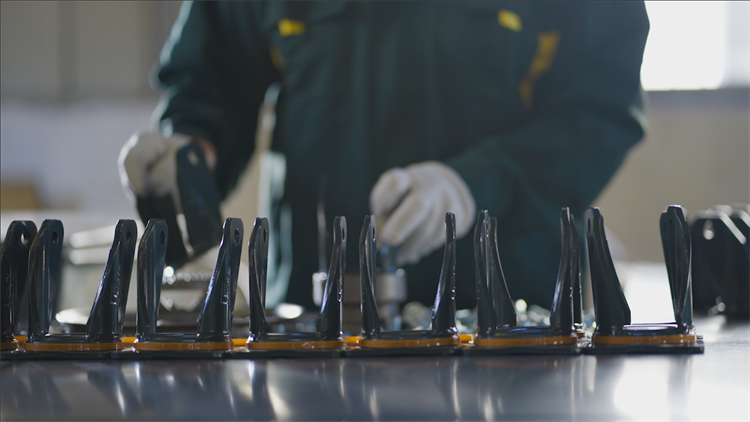
Meeting the demands of industrial intensity, Mingwei introduces casters with high-strength manganese steel, thickened brackets. Moving beyond standard stamping limitations, these brackets are formed from thick steel plate with reinforced manganese structures. They offer superior toughness, compression resistance, and shape retention. Even under the stress of high-volume warehouse handling or heavy material transport, the brackets remain rigid, ensuring straight tracking and smooth steering—eliminating drift and uneven wear at the source.
4. Seized Bearings? Poor Sealing Accelerates Failure
When a trolley becomes stiff, noisy, or the wheels lock up, the problem often lies within the bearings. Metallic dust, grime, moisture, and humidity in industrial settings are lethal to bearing life. Standard open-style bearings lack protection; contaminants infiltrate easily, causing ball bearing wear, rust, and seizure. This ruins the rolling feel and renders the caster useless.
Mingwei’s Precision Sealing:
Designed for harsh environments, Mingwei’s premium casters feature dual-lip sealed precision ball bearings. This robust sealing effectively blocks dust, metal filings, and moisture. Combined with precision-ground races, the bearings deliver smooth, quiet, low-resistance rolling. They resist rust and seizure over long-term use, minimizing maintenance and eliminating the hassle of frequent replacements.
The Often-Ignored Detail: Uniformity is Key to Longevity
A common mistake is mixing caster specifications on a single trolley—using different wheel diameters, materials, or load ratings, or mismatching swivel and rigid casters. This seemingly minor oversight creates uneven load distribution, tracking issues, and localized overload, drastically shortening equipment life.
Mingwei’s Tip: Always ensure uniformity in wheel diameter, material, and load rating across your trolley. While combining swivel and rigid casters is standard practice, their core specifications must match. Mingwei provides one-stop, customized wheel-set solutions tailored to your trolley model, load requirements, and operating environment—guaranteeing compatibility and preventing configuration-related failures.
Choose Mingwei, End the Cycle of Constant Replacement
In summary, frequent caster failure isn’t just about “you get what you pay for.” It’s primarily about mismatched specifications and unsuitable configurations. Blindly replacing worn parts only consumes more time, money, and manpower.
Mingwei Casters is rooted in real-world industrial and commercial applications. Through relentless material R&D, structural optimization, and process upgrades, we engineer specialized casters for every scenario—balancing load, floor type, and usage frequency. We don’t just pile on costs; we deliver highly compatible, durable, and cost-effective solutions. Solve the pain points of wear, jamming, and deformation, slash your operational costs, and make your handling smoother, your equipment tougher, and your production more efficient.